



Medical Device Prototype to Industrialization: A Complete Guide
A working prototype proves that a medical device design does what it is meant to do. Industrialization is what turns that prototype into a product that can be built the same way, to the same standard, at the volumes a market actually needs. This guide walks through what that transition involves.
Medical Device Prototype to Industrialization: The Basics
A prototype is built to prove a concept. It might be hand-built from a small batch of parts and tested under conditions that do not reflect a real production line. Industrialization replaces that with a process, spanning qualified suppliers, validated equipment, and documented steps that produce the same result every time.
For a medical device, that process has to satisfy regulators as well as a production line. Every step in getting there, from design through validation, needs to hold up to an audit.
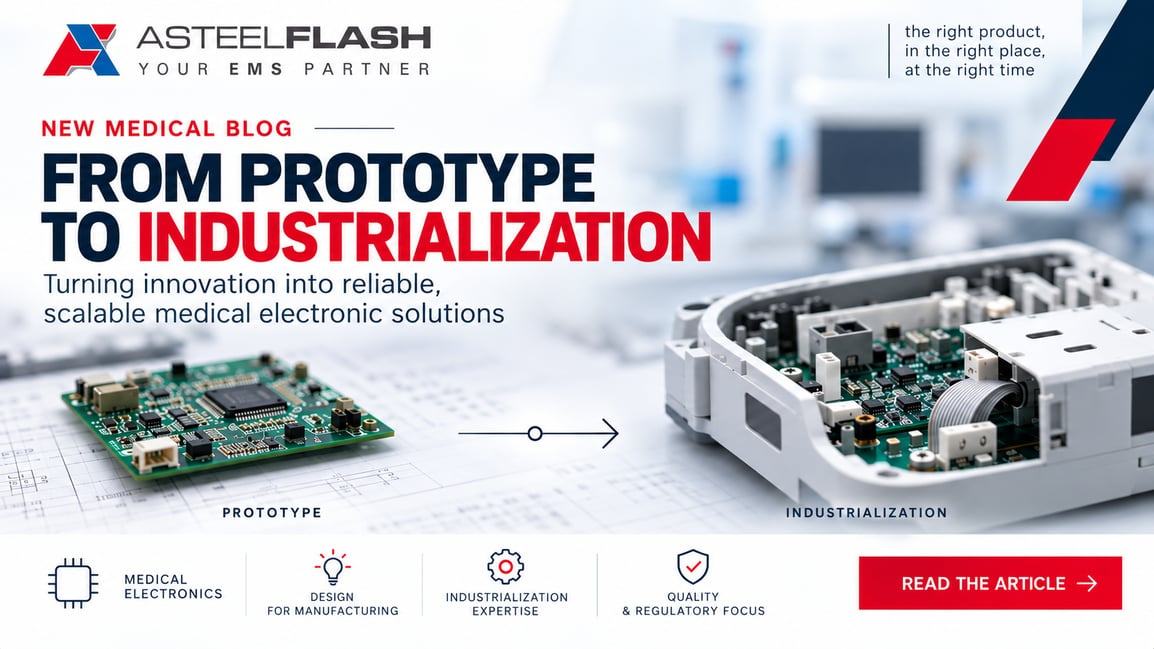
From Prototype to Industrialization: Four Key Stages
Getting from a working prototype to a product ready for volume production runs through four broad areas of work. They overlap in practice, and a strong contract manufacturer starts on some of them before the design is even finished, but each addresses a different kind of risk.
Designing the Product to Be Manufacturable
Before a design goes to tooling, it needs to be checked against what a production line can actually build repeatedly. That review, sometimes called design for excellence, breaks down into several related checks:
- Design for manufacturability: whether the layout and materials suit stable, repeatable production.
- Design for assembly: whether the mechanical design can be built without excessive manual work.
- Design for testability: whether the board and product can be tested efficiently once built.
- Design for procurement: whether the components specified will still be sourceable at volume.
Catching a manufacturability problem at this stage costs a design review. Catching it after tooling (or after a design has gone through validation) costs a redesign. In a regulated product, that usually means revalidating whatever changed.
Regulatory Compliance and Quality Systems
A medical device manufacturer works inside a quality management system built to ISO 13485, and that system has to be in place before production starts (not built around it afterward). Design controls sit at the center of it. A documented plan covers how the design will be:
- Verified against its requirements.
- Validated against how it will actually be used.
- Transferred from development into production without anything getting lost in the handoff.
Device-specific standards layer on top of that baseline. Electrical medical equipment is typically built to IEC 60601, and where a device includes software, IEC 62304 governs how that software is developed and controlled throughout its lifecycle. None of this replaces the OEM's own regulatory submissions to bodies like the FDA or under EU MDR. A manufacturing partner's certifications and documented processes support that compliance work.
Supply Chain and Parts-Obsolescence Planning
Every component in a medical device's bill of materials has to stay available for as long as the device stays on the market, which for some devices is a decade or more. Sourcing decisions made during design need to account for what happens when a part reaches end of life.
The practical response is a mix of approved vendor lists, qualified second sources for critical components, and active monitoring of supplier product change notifications, so a discontinuation gets flagged and an alternate evaluated before it forces a production stop.
Where a substitute is needed, the change goes back through the OEM and, if the part affects performance, through revalidation. Long lead-time components are ordered early for the same reason: committing to them before the rest of the design is settled is safer than discovering a shortage once the line is running.
Scaling Up Production and Testing
Moving from a pilot build to full production is where a validated process gets tested at scale. That step typically runs through an IQ/OQ/PQ framework:
- Installation qualification confirms the equipment is installed and configured correctly.
- Operational qualification confirms the process runs consistently across its defined parameters.
- Performance qualification confirms it holds up over a sustained run rather than just a handful of units.
The same test strategy defined during design has to scale with it. A functional test built for a bench prototype needs to become something a line can run on every unit without slowing production down. Any change made along the way (whether to a fixture, a supplier, or a process step) gets evaluated for whether it affects a result that was already validated. Moving production between sites raises the same question: a line replicated elsewhere has to be requalified before it can run the same validated process.
Partner with Asteelflash
Asteelflash supports medical device programs from prototype through full-scale production across seven ISO 13485 certified facilities, part of a wider network of 18 sites on four continents. That reach means a device can move from an early build to higher-volume production without leaving its validated process behind, moving to whichever site best balances proximity to the market and production cost.
Explore Asteelflash's capabilities to see how that translates to your program.
FAQs
Which Markets Does Asteelflash Serve?
Asteelflash works across a range of industries, including
- Medical
- Aerospace and defence
- Automotive
- Energy management
- Industrial
- Smart home
- Smart building
- Transportation
- Robotics
What Is the Difference Between Verification and Validation?
Verification confirms that a design meets its own specifications. Validation confirms that the finished device meets the needs of the people who will actually use it.
What Is Design Transfer?
Design transfer is the point where a design moves from development into production, with every requirement translated into a manufacturing specification the production line can actually build to.
What Is Process Validation (IQ/OQ/PQ)?
Process validation confirms a manufacturing process performs as intended, using three stages: installation qualification checks the equipment is set up correctly, operational qualification confirms it runs consistently, and performance qualification proves it holds up over a sustained run.
How Do You Manage Component Obsolescence and Supply Continuity?
By qualifying more than one source for critical components, monitoring supplier notifications for parts nearing end of life, and evaluating alternates early enough that a substitution never forces a production stop.